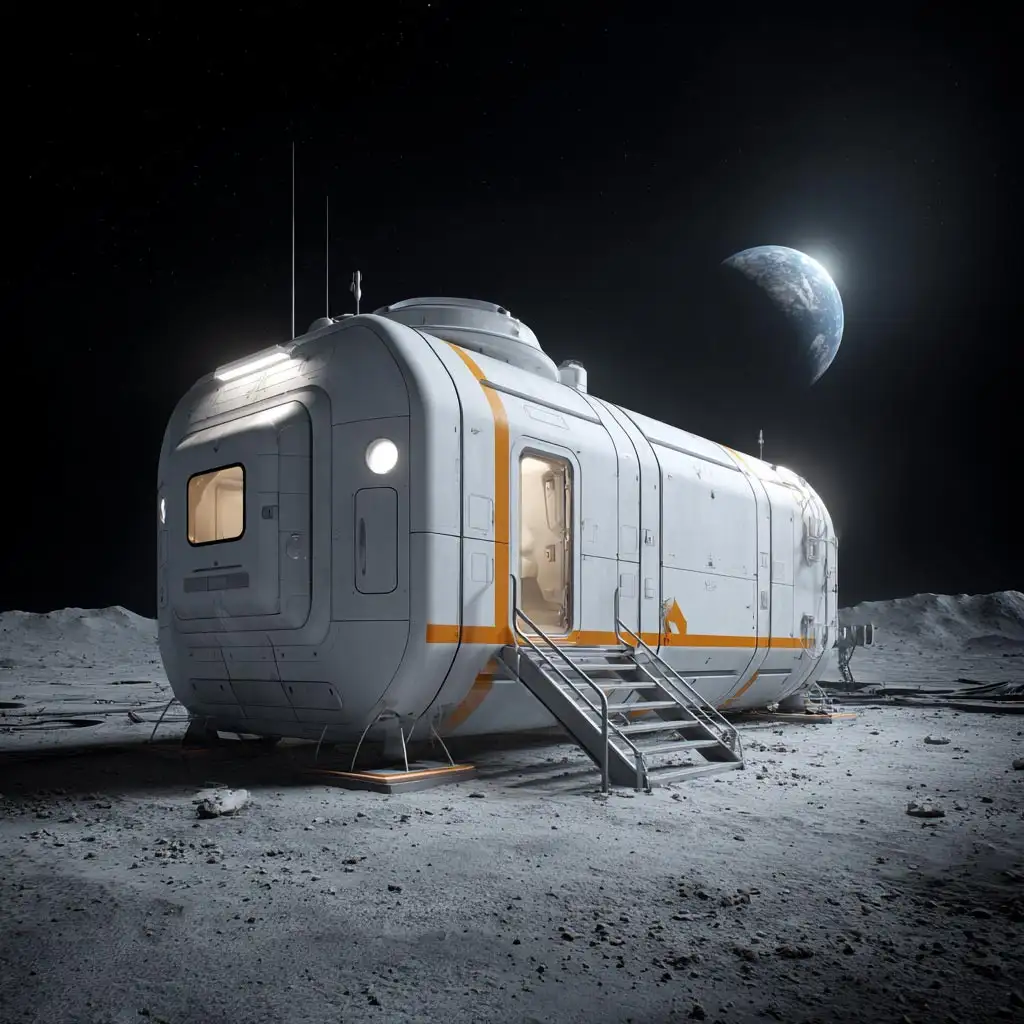
A Box with a Roof and a Door
Home
The future isn't found — it's constructed

For thousands of years, humanity built homes to expand what was possible—from caves to castles to cities that scrape the sky.
Now, for the first time, we're building beyond Earth. Not as an escape. But as an extension. A new kind of home—rooted in Earth, rising to the Moon—what some are beginning to call humanity's eighth continent.
What we are building
We have the blueprints, designs, scale models, and frameworks to build the first livable structures on the Moon. Not as a one-off station or speculative dream, but as part of a 4Phase development plan that spans 40 years.
Phase 1 begins with a Box with a Roof and a Door—a home for 8 individuals. Phase 2 expands into an Industrial Park for 90, where industries can take root. Phase 3 enables Extended Stay for 578, solving for radiation, life support, and long-term habitation. Phase 4 forms a Community of 1,644.
We are not asking why you want to go to the Moon—whether for research, resilience, expansion, or exploration. We are saying: if you are going to build, this is the way to build it. Modular, scalable, and rooted in real-world construction principles. The aim isn't to visit the Moon. It's to stay—and to build it as an extension of home, just as humanity has done with caves, castles, and cities throughout history.
Strategic Framework
We are executing a 4PHASE development plan — four distinct stages of Moon development over 40 years, beginning in 2023. Each phase is engineered not as theory, but as a construction sequence: modular, scalable, and grounded in the realities of building in harsh environments.
- Phase 1: Moon Hut A Box with a Roof and a Door, a functional home for 8 individuals. This is where habitation begins, with Earth-standard systems for air, water, power, and protection.
- Phase 2: Industrial Park Expansion into a working hub for 90 people. Here, industries can establish operations and supply chains that make permanence possible.
- Phase 3: Extended Stay Scaling habitation to 578, solving the real challenges of radiation, psychology, and long-duration living.
- Phase 4: Community A home for 1,644 individuals, designed for continuity of operations, cultural life, and multi-generational presence.
Every structure begins with modular, node-based architecture transported from Earth, then assembled or expanded on the Moon. Over time, operations transition toward in-situ development — shifting from shipped modules to locally supported infrastructure.
This is not about one-off visits, illustrations of giant colonies, or speculative technologies like 3D printing entire cities. This is about building with the methods we know work, sequenced for long-term viability. If humanity is to stay on the Moon, this is the way to build it.
Progress Report: Where we are...
This is not theory — it's work already done. Over the past several years, thousands of hours have gone into modeling, designing, and structuring the build sequence.
- 4Phase development model finalized: Home → Industrial Park → Extended Stay → Community.
- Phase 1 (Moon Hut) complete: Box with a Roof and a Door design framework finished; over 3,000 hours across 8 months invested in scale modeling.
- Phase 2 (Industrial Park) complete: Design framework finalized; over 10,000 hours across 18 months invested in full modeling.
- Technical papers drafted: Structural, systems, and modular architecture documented.
- Entity and legal structure established: Mearth Space Industries formed, with IP pathways and frameworks under international legal review.
- Intellectual property initiated: Copyrights, filings, and design protections in motion.
- Strategy decks and presentations developed: Used for capital raising, alliances, and technical validation.
- Early contributor and partner outreach underway: Builders, engineers, and operators engaged.
- Capital roadmap initiated: Active fundraising aligned with staged development.
The result: Phase 1 and Phase 2 designs are complete, documented, and validated.
We're not speculating. We're building.
Want to shape this ?
We're not asking for dreamers. We're asking for builders. The work ahead requires those who know how to design, construct, and operate at scale in one of the harshest environments humanity has ever faced.
Some of the skills we're welcoming:
- Life Support Specialists: air, water, thermal, and power systems engineered for long-term use.
- Systems Engineers & Architects: integration of modular, node-based designs.
- Planetologists & Location Specialists: site selection and environmental assessment.
- Experts in Human Factors & Moon-based Psychology: preparing for extended stay in confined, high-stress environments.
- Robotics & Automation Engineers: advanced construction and operational systems.
- Structural Engineers & Builders: proven capability in large-scale, high-resilience design.
- Leaders in Logistics, Comms, and Operations: orchestrating movement, supply, and coordination under extreme conditions.
- Generalists who see across domains: able to connect architecture, engineering, and human systems.
We also need leaders — COOs, CTOs, CFOs — those who can manage, coordinate, communicate, fundraise, and operate at scale. If you've run a company, delivered a major project, or brought teams to life, this is where you step in.
What Type of Builder Are You ?
Are you a system-builder? A strategist? A storyteller? An engineer, operator, or funder?
If you feel the pull to help build the first real home beyond Earth — this is your invitation.
Each write-up here is just a starting point. Behind every initiative is a detailed pitch deck that outlines the vision, structure, and next steps. Because these decks contain sensitive material, access is provided by request.